El Hermoso Dia

Tan jovial esta el prado
Y el azul tan sereno
Que me he sentido bueno
Con todo lo creado.

El sol, desde su asomo,
Derramo por mi estancia
El oro y la fragrancia
Del polen del aromo.

Sentimental, el asno
Rebuzna su morrina
Y ayer, como una nina,
Florecio ya el durazno.

Radiant Day

The sun’s ascent
spills over bronze
mountains and breathes
juniper scent.

The desert is bright
and the sky so blue
that I am struck blind
untethered from sight.

The coyote den barks
like a girl awakened,
her dreams ripped away,
homesick for sweet dark.
Brian Evenson “The Glassy, Burning Floor of Hell” – Álvar Núñez Cabeza de Vaca “Chronicle of the Narváez Expedition” – Joy Williams “Breaking & Entering” – Jorge Luis Borges “A Course on English Literature”

In Evenson’s stories, it always feels like something is missing, like the characters need to recover what they haven’t realized is gone. His settings are empty landscapes, undescribed except to mention objects that advance or impede narrative progress.
At the dawn of Spanish imperialism in the Americas, Cabeza de Vaca also wrote about desolate places. The difficulty of traveling through landscapes of stagnant lakes and dead trees cut Cabeza de Vaca’s expedition from a force of 300 men to four hungry, cold, and desperate survivors.
Cabeza de Vaca spent nine years trying to make his way from Texas to Mexico City. Throughout his chronicle, one unsettling pattern repeats itself – soon after he and his companions arrive at new communities, those communities are overwhelmed by disease.
By the time the next Europeans reached the regions where he had traveled, many of the nations and languages he described had vanished. His chronicle is the only written record of these peoples’ existence – written by the man probably responsible for spreading the diseases that killed them.
Joy Williams writes about Florida, the place where Cabeza de Vaca’s ships first landed. Breaking and Entering has a mood that sometimes parallels Evenson’s stories – Liberty, the main character, wanders through her days talking to neighbors and watching the ocean, but something is missing. When her suicide attempt is revealed, it becomes clear that what’s missing is Liberty herself.
In his lectures on English literature, Borges said that pre-Beowulf, “sentiment for the natural world… does not appear” in European literature. He also claims that early Germanic literature never mentioned color.
Cabeza de Vaca described cultures that were exterminated because he witnessed them. Joy Williams describes pseudo-ghosts stuck in a living world. Evenson describes landscapes that prefigure a dead planet. Each of them takes away what was once there. If it took European literature hundreds of years to build a language of life, of color, of the natural world, these three books do the opposite – here, Western writers slowly strip life away, until all that remains are ghost people on a ghost world.
Home – Translations & Criticism
Julio Cortázar “All Fires the Fire” – Roberto Calasso “The Celestial Hunter” – Deirdre Madden “Molly Fox’s Birthday” – Sam Riviere “Dead Souls”
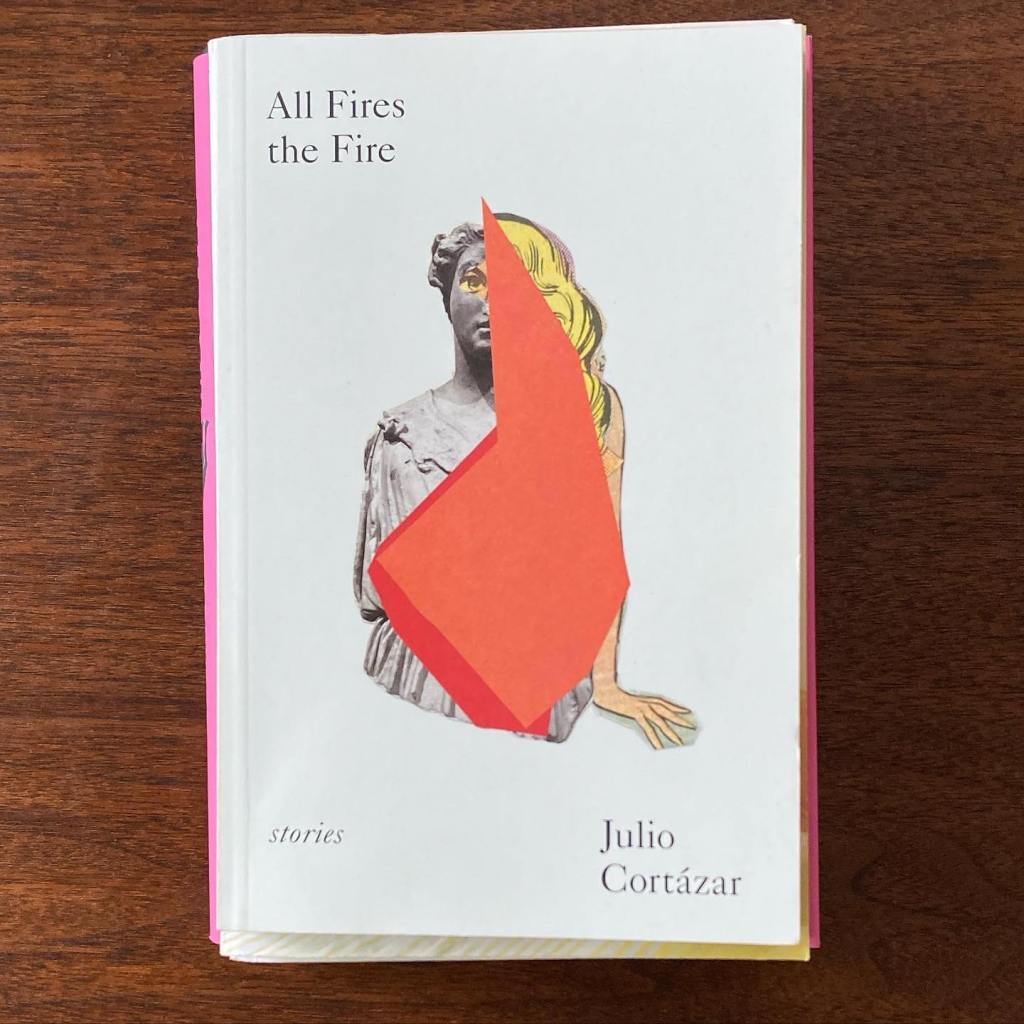
Many of Cortázar’s stories share the same form: two separate narratives (separated by time, by species, by distance) slowly become more similar, until they reveal they’ve always been the same narrative, pushing the reader into vertigo. They’re double narratives that hunt each other and both catch their prey.
Calasso also writes about hunters who become what they hunt. He writes that the first carnivorous ancestors of humans were scavengers. They ate what the predators who hunted them left behind – their fellow prey, what would become, if the predator’s next hunt was successful, themselves.
Calasso argues that sacrifice reenacts this primordial guilt. In sacrificial rituals, the killer paints themselves with the blood of what they killed, symbolically becoming the victim.
Madden’s novel describes another kind of symbolic imitation – writing and acting. Her story is about three friends, one a playwright, one an actor, one a critic. The playwright and actor are the closest of the three. In order to write roles for her friend, the playwright imitates how her friend would become them on stage. In order to act those roles, the actor imitates how her friend became them at the writing desk. They not only become these characters, they lose themselves in the person their friend thinks they are.
The critic, on the outskirts of their friendship, is also on the outskirts of this artistic process. Instead of entering into the work, he cordons himself apart from it in order to comment on it. His work is creative but not transformative.
There’s a strange and strong parallel between The Celestial Hunter and Dead Souls. Calasso’s book about hunting and imitation transforms, without much explanation, into a description of a higher realm where there is no difference, only simultaneity so undifferentiated it becomes nothingness. Riviere’s book is about a poet who gets in trouble for imitation and plagiarism, who confesses that, for him, writing poetry is “the replacement of things in the world with their absence.”
In the end, the only way for Riviere’s poet to escape the judgement of his peers is to voluntarily go to them, judge himself for his crimes of imitation, and sentence himself to a fitting punishment. Like Cortázar’s double narratives, Calasso’s sacrifices, and Madden’s friends, he becomes the hunter hunting himself.
Home – Translations & Criticism
E.T.A. Hoffman “Tales of Hoffmann” – Mark Fisher “The Weird and the Eerie” – Paul Scheerbart “Glass! Love!! Perpetual Motion!!!”
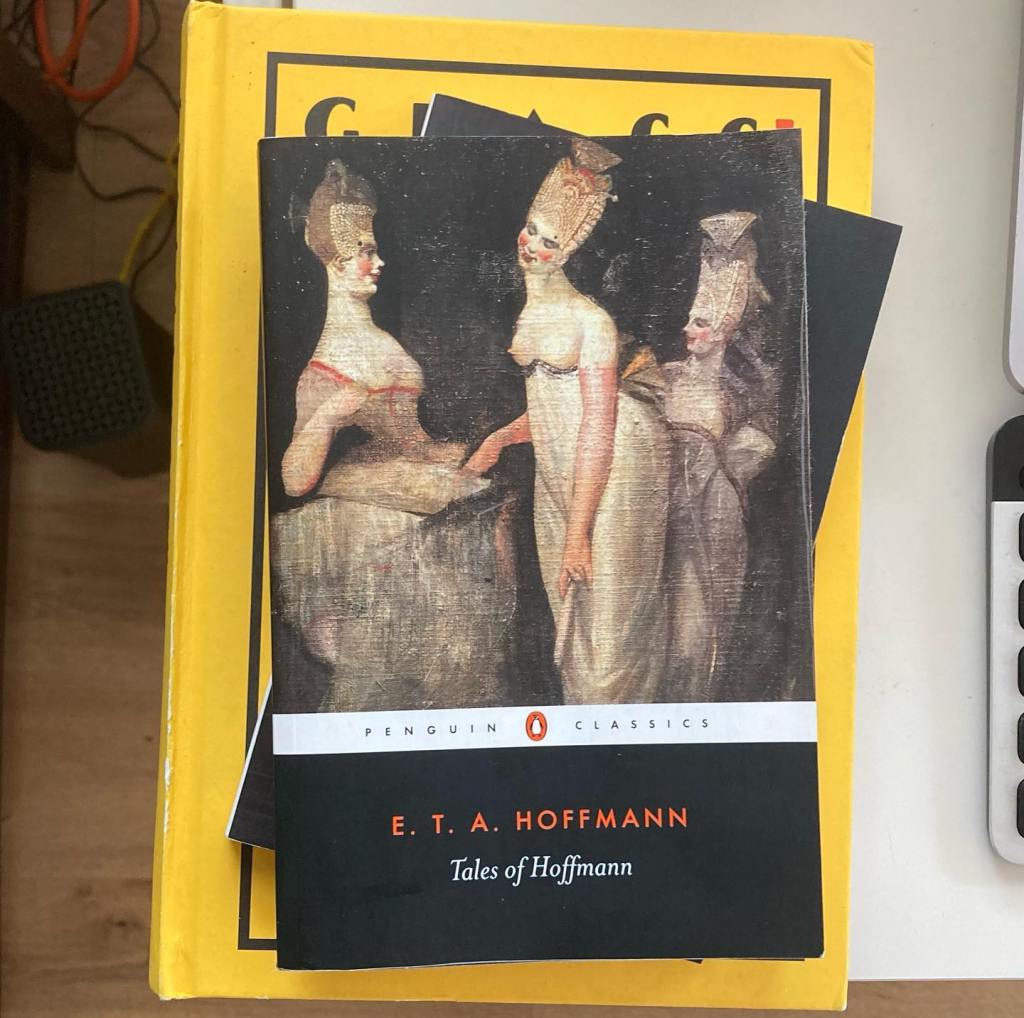
ETA Hoffmann’s gothic romances are full of implausible events and coincidences, but what makes his tales feel so unreal to a contemporary reader is the characters’ emotions. They’re never suspicious of their feelings – they immediately act in whatever way their heart tells them to.
In contemporary novels, characters mistrust and analyze and interrogate their emotions. Even when they decide to follow their hearts, authors devote dozens of pages to making sure readers understand what consciously or unconsciously motivated that decision.
Mark Fisher writes about the weird and the eerie, qualities that pervade gothic romances but are absent from most modern literature’s dominant genre, psychological realism (and the vast majority of today’s popular sci-fi, horror, and fantasy work adheres to psychological realism’s rules of character construction). He argues that the weird and the eerie occur when an element exists where nothing should exist or an element is missing where something should be.
I think this feels especially strange to contemporary readers who live in a culture dominated by scientific materialism. We instinctively trust measurements of a flower’s weight and height – but distrust the qualia of its color. How do we know you and I see the same blue? If we’re not seeing the same blue, does blue exist at all? The weird and the eerie are the unmeasurable aspects of reality erupting – they frighten us because we’ve been trained to ignore them.
Is that why contemporary writers dedicate so much space to motivating every character action? Nothing is more unmeasurable than emotion. It’s both what contemporary literature is about and what it can’t quite believe is real. Our stories are filled with irony that distances characters from the emotions they feel and readers from the stories they’re reading. Gothic tales are also full of irony, but it’s an entirely different kind – it’s the ironic coincidence, the ironic resonance, that brings themes and characters and readers closer together.
Paul Scheerbart wrote science fiction in the late 19th/early 20th centuries. He made many predictions about the future, few of which were accurate. Other classic sci-fi writers are praised for making correct predictions. But do we gain anything by reading writers who happened to guess write? We already know what they already told us. Instead, we should read the past’s greatest wrong sci-fi authors. Then, we could imagine a present other than the rationalism-bound one we have.
 Ted Hayden